AI Medical Imaging Platform Evaluation Guide 2026
Table of Contents
- Introduction
- 1. Define the Intended Use Before Comparing AI Medical Imaging Solutions
- 2. Check Regulatory Status and Clinical AI Validation
- 3. Test PACS Integration, RIS, DICOM, and EHR Workflow
- 4. Compare Deployment and Cybersecurity for Radiology AI Platforms
- 5. Use a Weighted Procurement Scorecard and Strong Contract
- 6. Run a Controlled Pilot With Predefined Metrics
- 7. Plan Explainability, Monitoring, Drift, and Governance
- Conclusion
- Introduction
- 1. Define the Intended Use Before Comparing AI Medical Imaging Solutions
- 2. Check Regulatory Status and Clinical AI Validation
- 3. Test PACS Integration, RIS, DICOM, and EHR Workflow
- 4. Compare Deployment and Cybersecurity for Radiology AI Platforms
- 5. Use a Weighted Procurement Scorecard and Strong Contract
- 6. Run a Controlled Pilot With Predefined Metrics
- 7. Plan Explainability, Monitoring, Drift, and Governance
- Conclusion
Introduction
An AI medical imaging platform can flag urgent scans, measure anatomy, support interpretation, or route findings for follow-up. Yet a strong demonstration does not prove the software will work safely in your hospital. Performance can change with the patient population, scanner model, imaging protocol, or workflow.
This 2026 guide helps hospitals, radiology groups, imaging centers, and health plans evaluate medical imaging AI software beyond vendor claims. It covers intended use, regulatory status, clinical validation, PACS and RIS integration, DICOM, deployment, cybersecurity, monitoring, contracting, and pilot design. It also includes a procurement scorecard and risk checklist.
TL;DR: Buy for a defined clinical problem, then test the AI medical imaging platform with your own data and workflow. Use this guide for procurement and governance decisions. It does not provide medical advice.
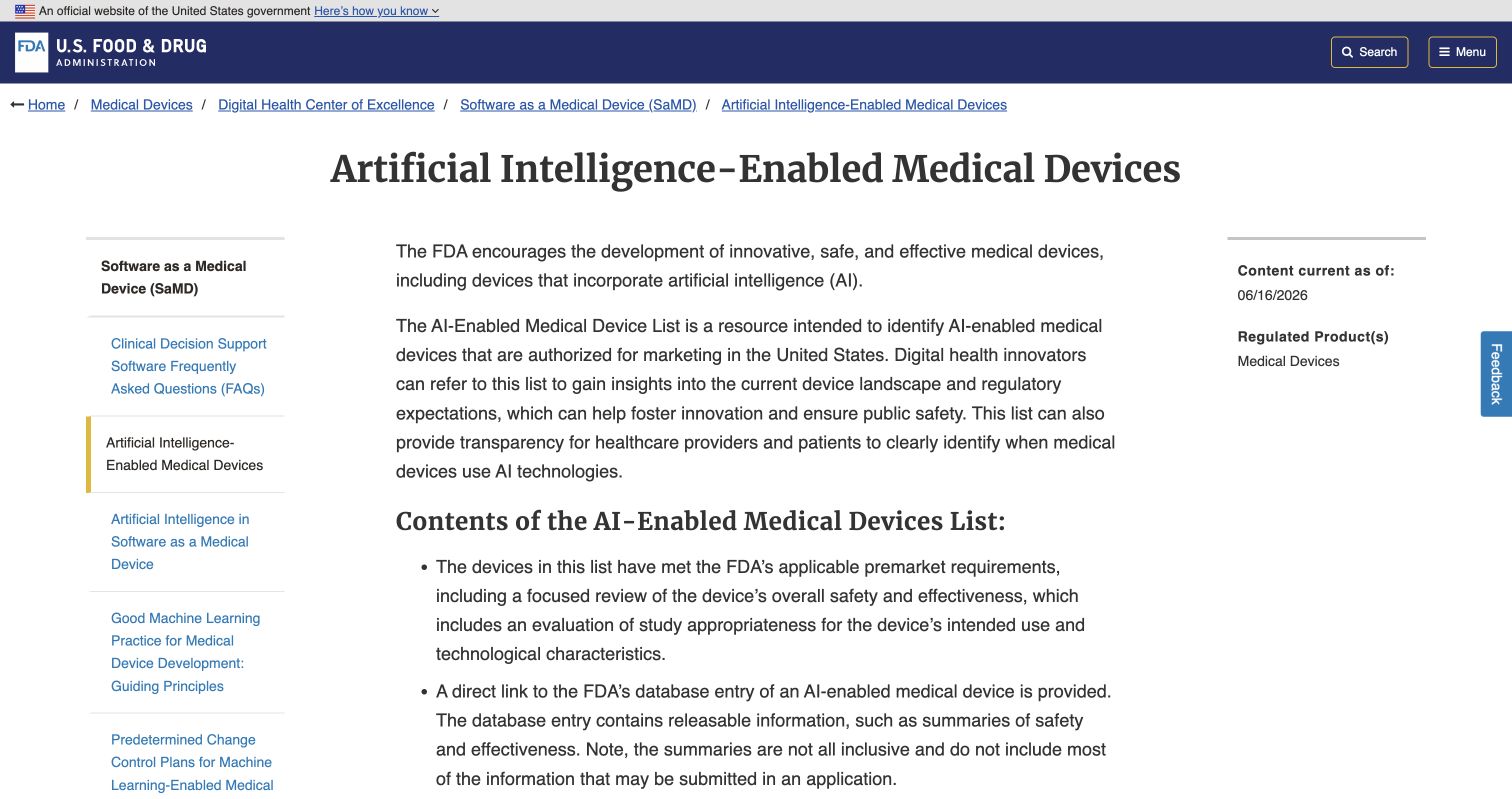
Screenshot: FDA Artificial Intelligence-Enabled Medical Devices resource, captured July 2026. Buyers should verify the current authorization record for each product and intended use.
1. Define the Intended Use Before Comparing AI Medical Imaging Solutions
Start with the job. “Improve radiology” is too broad to evaluate. Instead, identify the patient group, modality, indication, user, output, and affected decision.
For example, a hospital might use AI to prioritize adult non-contrast head CT studies with suspected intracranial hemorrhage. That is different from software that detects hemorrhage, measures its volume, drafts a report, or sends an alert to a stroke team. Each use has different evidence, integration, and safety requirements.
| Intended-use question | What the buyer should define | Example |
|---|---|---|
| Clinical problem | The delay, error, or workload issue | Long turnaround time for urgent head CT |
| Population | Age, setting, exclusions, and relevant demographics | Adults in the emergency department |
| Modality | CT, MRI, X-ray, ultrasound, mammography, or another format | Non-contrast head CT |
| Indication | The specific condition or finding | Suspected intracranial hemorrhage |
| Output | Alert, score, segmentation, measurement, or draft | Worklist-priority notification |
| User and action | Who receives the result and what they may do | Radiologist reviews the study sooner |
Check modality fit closely. Do not assume an algorithm evaluated on standard chest radiographs works on portable images, pediatric studies, or different protocols. Likewise, CT software does not automatically cover MRI, and a model cleared for one anatomical region does not gain permission for another.
Useful real-world applications include:
- Prioritizing time-sensitive CT studies for radiologist review
- Acting as a second reader for mammography or chest X-ray
- Producing measurements or segmentations for treatment planning
- Finding incidental lung nodules and routing them to a follow-up program
- Checking image quality before a patient leaves the scanner
These remain different products when sold through one radiology AI platform. Evaluate every model and intended use separately.
2. Check Regulatory Status and Clinical AI Validation
In the United States, search the FDA AI-Enabled Medical Device List, then open the linked 510(k), De Novo, or premarket approval record. The FDA says its list identifies authorized devices that it has found, but it is not complete. More importantly, authorization applies to a particular device, version, intended use, and labeling. It does not clear the entire platform for every advertised task.
Record these details in the procurement file:
- Submission number and regulatory pathway
- Exact product and software version
- Indications for use and contraindications
- Required human oversight
- Supported modalities, acquisition protocols, and patient groups
- Whether the marketed feature matches the authorized feature
- Whether planned updates fall under an authorized change process
The FDA’s final 2025 guidance on predetermined change control plans addresses how certain planned modifications may be reviewed in advance. Still require notice of model, threshold, interface, and labeling changes.
Regulatory authorization neither proves local effectiveness nor replaces clinical AI validation. Ask for peer-reviewed studies, full study protocols, confidence intervals, subgroup results, and evidence from sites that were not involved in training. A systematic review of 86 radiology algorithms found reduced external-data performance in 81%. In 24%, the decrease was at least 0.10 on the reported unit scale. The Radiology: Artificial Intelligence review is a useful warning against accepting internal validation alone.
Compare the study population with your patients and scanners. Look for sensitivity, specificity, positive predictive value, negative predictive value, calibration, false alerts per study, and unreadable-study rates. Accuracy alone can hide clinically important errors.
3. Test PACS Integration, RIS, DICOM, and EHR Workflow
An accurate algorithm may add work by requiring another application. Before selecting software, map the path from image acquisition through PACS integration to clinical action.
The normal technical path may include:
- A modality creates the study and sends it to the PACS or vendor-neutral archive.
- A routing rule sends eligible images to the AI medical imaging platform.
- The model processes the study and returns a result.
- The PACS, RIS, worklist, or viewer displays the result in context.
- The EHR records an alert, follow-up task, or clinical communication when needed.
- Logs record delivery, review, acknowledgement, overrides, and failures.
DICOM is the international standard for medical images and related information. It supports storing, sending, querying, retrieving, and processing images across modalities, PACS, and other systems, according to the official DICOM overview. However, claimed DICOM support does not guarantee interoperability. Require the vendor’s DICOM Conformance Statement and test the services, transfer syntaxes, metadata, structured reports, segmentations, and secondary captures you will use.
Ask whether the platform supports:
- DICOM C-STORE, query/retrieve, DICOMweb, and required result objects
- HL7 v2 messages for orders, results, and patient updates
- FHIR APIs where the EHR workflow calls for them
- Single sign-on, role-based access, and audit logging
- Native PACS worklist changes rather than a separate dashboard
- Epic and Oracle Health integrations through supported interfaces rather than screenshots or manual copying
Integration claims should specify the tested PACS, RIS, EHR version, interface engine, and workflow. A connector used by another Epic or Oracle Health customer may still require local integration, configuration, and validation.
4. Compare Deployment and Cybersecurity for Radiology AI Platforms
Radiology AI platforms run in the cloud, locally, or through a hybrid design. No deployment model is universally best. Choose based on image volume, network capacity, downtime tolerance, security policy, and required speed.
| Deployment | Advantages | Questions and tradeoffs |
|---|---|---|
| Cloud | Faster central updates and less local compute | Upload capacity, data location, outage behavior, and recurring processing costs |
| On-premises | Greater local control and lower dependence on external connectivity | Hardware cost, patching, capacity planning, and local support burden |
| Hybrid or edge | Local image processing with centralized management | More components, version coordination, and unclear support boundaries |
Measure expected and peak study volume. Stroke triage may require results within minutes; retrospective incidental-finding searches may tolerate hours. Test large studies, simultaneous arrivals, planned maintenance, and loss of internet access. Define whether images queue, fail safely, or leave the AI workflow during outages.
A badge or hosting region does not establish HIPAA compliance. When a cloud provider creates, receives, maintains, or transmits electronic protected health information, HHS generally treats it as a business associate. The organization needs a business associate agreement and its own risk analysis, as explained in the HHS cloud-computing guidance.
Use this risk checklist before approving an AI medical imaging solution:
| Risk area | What to check | Why it matters |
|---|---|---|
| Data use | Contractual limits on training, resale, and secondary use | A BAA alone may not settle every permitted use |
| Encryption | Encryption in transit and at rest, with documented key management | Imaging data contains sensitive identifiers |
| Access | SSO, least privilege, MFA, service-account controls, and access reviews | Shared or permanent credentials weaken accountability |
| Vulnerabilities | Software bill of materials, patch targets, penetration testing, and disclosure process | Unpatched components can expose PACS-connected systems |
| Incident response | Notification timing, investigation duties, evidence preservation, and contacts | Delayed reporting can worsen clinical and legal harm |
| Resilience | Backups, recovery objectives, failover, and tested downtime procedures | An alerting tool may become part of a time-sensitive workflow |
| Data lifecycle | Retention, deletion, export, subcontractors, and termination procedures | The hospital must know where every copy remains |
NIST’s AI Risk Management Framework can help governance teams organize responsibilities for mapping, measuring, and managing AI risks. It does not replace healthcare law, regulatory review, or clinical governance.
5. Use a Weighted Procurement Scorecard and Strong Contract
A scorecard keeps polished demonstrations from outweighing weak evidence or difficult integration. Set the weights before receiving final proposals. Score each category from 0 to 5, apply its weight, and document the evidence.
| Category | Weight | Evidence expected |
|---|---|---|
| Intended-use and modality fit | 15% | Exact match to population, modality, indication, and workflow |
| Regulatory status | 15% | FDA record or applicable local authorization for the proposed version and use |
| Clinical evidence | 20% | External and prospective validation, subgroup results, and uncertainty intervals |
| Local performance plan | 10% | Testable thresholds and access to case-level output |
| PACS, RIS, and EHR integration | 15% | Conformance documents, architecture, interface scope, and tested workflow |
| Security and privacy | 10% | BAA, risk documentation, audit results, access controls, and incident process |
| Operations and monitoring | 10% | Uptime, support, version control, drift monitoring, and escalation procedures |
| Commercial terms | 5% | Transparent total cost, exit rights, and data portability |
Points elsewhere should not offset regulatory or patient-safety failures. Establish minimum gates for intended-use fit, authorization, security, and local validation before calculating the commercial score.
The contract should list every licensed model, site, modality, and version. It should also address:
- Setup responsibilities and acceptance criteria
- Interface, hosting, storage, support, and upgrade fees
- Uptime and response-time service levels
- Notification and approval rules for model changes
- Access to performance logs and case-level exports
- Security incidents, indemnity, insurance, and allocation of responsibility
- Restrictions on use of hospital data for model development
- Data return or deletion at termination
- Assistance and costs for switching platforms
My blunt view: an easy exit matters almost as much as an easy launch. AI medical imaging solutions change quickly. Proprietary formats, long auto-renewals, or vendor-dependent interfaces should not trap a hospital.
6. Run a Controlled Pilot With Predefined Metrics
A pilot validates the complete clinical AI system; it is not a product demonstration. Include radiology, the relevant clinical service, IT, security, privacy, compliance, quality, and operations. Name a clinical owner and an operational owner.
A practical pilot plan follows six steps:
-
Write the hypothesis. State the expected clinical or operational outcome. For example, the AI medical imaging platform will reduce the median time from scan completion to radiologist opening for eligible emergency head CT studies.
-
Set a baseline. Measure several weeks of volume, turnaround time, error rates, escalation patterns, and staffing. Account for shifts, weekends, sites, and case mix.
-
Validate silently first. Run the model in shadow mode without affecting care. Compare its outputs with final reports, expert review, or another predefined reference standard. Investigate disagreements instead of counting wins and losses.
-
Set thresholds before viewing results. Define acceptable sensitivity, false alerts per 100 studies, processing latency, technical failure rate, and subgroup performance. Include a stopping rule for unexpected harm or excessive alerting.
-
Conduct limited clinical use. Start with specific users, shifts, or sites. Train users on intended use, limitations, downtime, and how to report a questionable result.
-
Decide with evidence. Expand, require correction, extend the pilot, or stop. Record the decision and unresolved risks.
Track technical, clinical, workflow, and adoption metrics:
| Pilot metric | Suggested measurement |
|---|---|
| Eligibility coverage | Eligible studies processed ÷ all eligible studies |
| Sensitivity and specificity | Results against the predefined local reference standard |
| Alert burden | False or non-actionable alerts per 100 processed studies |
| Latency | Median and 95th-percentile time from image availability to result delivery |
| Turnaround time | Baseline versus pilot, including median and 90th percentile |
| Technical reliability | Failed, delayed, duplicated, or mismatched results |
| User response | Result-view and acknowledgement rates, overrides, and survey findings |
| Equity | Performance by age, sex, race or ethnicity where appropriate, site, scanner, and care setting |
A CT triage pilot should measure time to worklist review, not merely detection accuracy. A mammography second-reader pilot should study recall, cancer detection, reader workload, and arbitration. A chest X-ray quality tool should measure repeat imaging and technologist workflow. An incidental-nodule solution should measure completed follow-up, not the number of findings extracted. The metric must follow the intended action.
7. Plan Explainability, Monitoring, Drift, and Governance
Explainability should help the intended user act safely. A heat map may help one detection task but mislead another. Measurements, confidence values, source images, comparison data, or a traceable report sentence may be more useful. Ask what each explanation represents, how it was validated, and when it can be wrong.
Users also need practical information:
- What the medical imaging AI software is designed to detect or measure
- Which studies it excludes or cannot process
- Whether a negative result can safely change the normal review process
- How uncertainty and technical failure are displayed
- Who retains responsibility for the clinical decision
- How to report an apparent false result or unsafe behavior
Performance monitoring begins at launch. Scanner replacements, protocol or routing changes, population shifts, software updates, and compression can alter inputs. Drift may appear as changing sensitivity, alert prevalence, unreadable-study rates, or disagreement with radiology reports.
The American College of Radiology’s Assess-AI program describes monitoring model inputs, versions, and concordance with radiology reports. A local program should review those measures according to clinical risk.
Create an inventory containing the model owner, version, intended use, regulatory record, interfaces, validation date, monitoring thresholds, and retirement plan. Assign escalation levels for:
- A single questionable result requiring case review
- A recurring performance or routing problem
- A safety event requiring temporary suspension
- A vendor update requiring revalidation
Prohibit silent model updates. Even under an authorized change plan, require release notes, impact analysis, test results, deployment timing, rollback capability, and a local revalidation decision.
Conclusion
Choosing an AI medical imaging platform requires evidence, integration testing, and clinical AI validation, not a feature contest. Define one problem, then confirm the population, modality, indication, output, and user action. Then verify regulatory status, external evidence, local performance, DICOM behavior, PACS and EHR integration, security, and total cost.
A controlled pilot should measure patient-safety signals, technical reliability, workflow effects, subgroup performance, and alert burden against thresholds written in advance. After launch, maintain a model inventory, monitor drift, investigate failures, and revalidate meaningful changes.
Next, turn this scorecard and risk checklist into an organization-specific request for proposal. Require documents and testable commitments from vendors. Claims make a shortlist; evidence earns deployment.
Frequently asked questions
Who should be involved in evaluating an AI medical imaging platform?
Include radiologists, relevant clinical services, IT, cybersecurity, privacy, compliance, quality, procurement, and operations. Assign both a clinical owner and an operational owner so patient-safety and workflow responsibilities remain clear.
What documents should we request from a vendor before starting a pilot?
Request regulatory records, intended-use labeling, external validation studies, subgroup results, a DICOM Conformance Statement, security documentation, and a complete deployment architecture. Also obtain release notes, support commitments, data-use terms, and an itemized estimate of implementation and ongoing costs.
Should the AI be tested in shadow mode before clinicians use its results?
Yes. Shadow mode allows the organization to measure local accuracy, processing failures, latency, and alert volume without influencing patient care. Investigate disagreements against a predefined reference standard before moving to limited clinical use.
How should hospitals prepare for an AI platform outage?
Document whether studies will queue, bypass the system, or require manual handling during network, vendor, or local infrastructure failures. Users should know that normal review processes remain in effect, while IT and clinical teams need tested escalation, recovery, and reconciliation procedures.
What should happen when the vendor releases a model update?
Require advance notice, release notes, an impact assessment, test results, and a rollback plan. Changes to the model, threshold, interface, or labeling should undergo risk-based local testing before production deployment, even when covered by an authorized change process.
How can we prevent vendor lock-in?
Negotiate access to case-level results, performance logs, standard-format exports, and interface documentation. The contract should also define termination assistance, data deletion or return, transition costs, renewal terms, and the hospital’s right to discontinue models that fail safety or performance requirements.
When should an imaging AI model be suspended or retired?
Suspend use when monitoring reveals a credible safety concern, recurring routing failure, unacceptable alert burden, or performance below predefined thresholds. Retirement may be appropriate when the clinical need changes, support ends, replacement systems perform better, or the vendor cannot resolve persistent regulatory, security, or workflow risks.
Does FDA clearance prove that an AI medical imaging platform will work at our hospital?
No. Authorization indicates that the reviewed device met applicable requirements for its stated intended use. It does not prove equal performance across patient populations, scanners, protocols, PACS, or workflows. Confirm the version and use, then validate locally.
Should we buy one platform or separate specialist tools?
A platform can reduce interface and support work, while specialist tools may offer closer clinical fit. Compare both approaches using the same scorecard. Count every interface, model, viewer, upgrade, and support cost. Do not assume that all models on one radiology AI platform share the same evidence or authorization.
Is cloud-based medical imaging AI software HIPAA compliant?
Cloud deployment can support HIPAA compliance, but hospitals and business associates retain responsibilities. Review the BAA, data flows, subcontractors, access controls, security evidence, incident duties, retention, and your own risk analysis.
How long should a pilot last?
Adequate case volume and representative coverage matter more than duration. Include normal and peak workloads, relevant findings, major scanners, sites, shifts, and patient subgroups. Rare findings may require retrospective enrichment followed by prospective observation. Document why the sample can support the decision.
What if a model performs well but creates too many alerts?
Treat alert burden as a safety and workflow measure. Review thresholds, prevalence, duplicate notifications, recipient rules, and the action expected after each alert. Retest tuning that remains within authorized use and can be validated. Otherwise, do not deploy simply because sensitivity is high.
Can AI replace the radiologist’s review?
Do not assume so. Follow the product’s authorized intended use and labeling. Many solutions assist prioritization, detection, measurement, or interpretation but require qualified human review. Procurement materials should never broaden the product’s approved role.