HIPAA, BAA, PHI & PII for Healthcare AI Teams
Table of Contents
- Why HIPAA, BAA, PHI, and PII Matter Before You Use AI in Healthcare
- What Is HIPAA? HIPAA Compliance AI Teams Need in One Page
- What Is BAA? What a Business Associate Agreement Does and Does Not Do
- PII vs PHI: What Is PII, What Is PHI, and What Counts as Sensitive Data
- The 18 HIPAA Identifiers: Safe Harbor Identifiers for De-Identification Healthcare Workflows
- What to Redact Before Using AI Tools for Patient Data AI
- Checklist for Teams Building or Buying Healthcare AI Tools
- Bringing It All Together
- Why HIPAA, BAA, PHI, and PII Matter Before You Use AI in Healthcare
- What Is HIPAA? HIPAA Compliance AI Teams Need in One Page
- What Is BAA? What a Business Associate Agreement Does and Does Not Do
- PII vs PHI: What Is PII, What Is PHI, and What Counts as Sensitive Data
- The 18 HIPAA Identifiers: Safe Harbor Identifiers for De-Identification Healthcare Workflows
- What to Redact Before Using AI Tools for Patient Data AI
- Checklist for Teams Building or Buying Healthcare AI Tools
- Bringing It All Together
Why HIPAA, BAA, PHI, and PII Matter Before You Use AI in Healthcare
If your team is evaluating an AI product for clinical documentation, revenue cycle management, patient engagement, or any other healthcare workflow, you’ll run into four questions almost immediately.
These questions are:
- what is HIPAA?
- what is BAA?
- what is PHI?
- what is PII?
PHI vs PII Identifier Checker
Select a data element to understand whether it qualifies as PII, PHI, or both, and why it matters for your AI pipeline.
Vendor pitches, security questionnaires, and compliance reveiws often use them loosely or incorrectly.
Mistakes have real consequences. A misunderstanding about what counts as PHI can mean you send patient data to a tool thaat has no business seeing it. A missing BAA can turn a routine integration into a reportable breach. And the difference bettween PII and PHI matters more than most people realize when you’re deciding what to redact before feeding data into an AI model.
This article defines each term, explains PII vs PHI edge cases, and gives your team a checklist for responsible healthcare AI.
What Is HIPAA? HIPAA Compliance AI Teams Need in One Page
HIPAA, the Health Insurance Portability and Accountability Act, is a U.S. federal law passed in 1996. It sets national standards for protecting individuals’ health information. If you work with U.S. patient data, HIPAA is your legal framework.
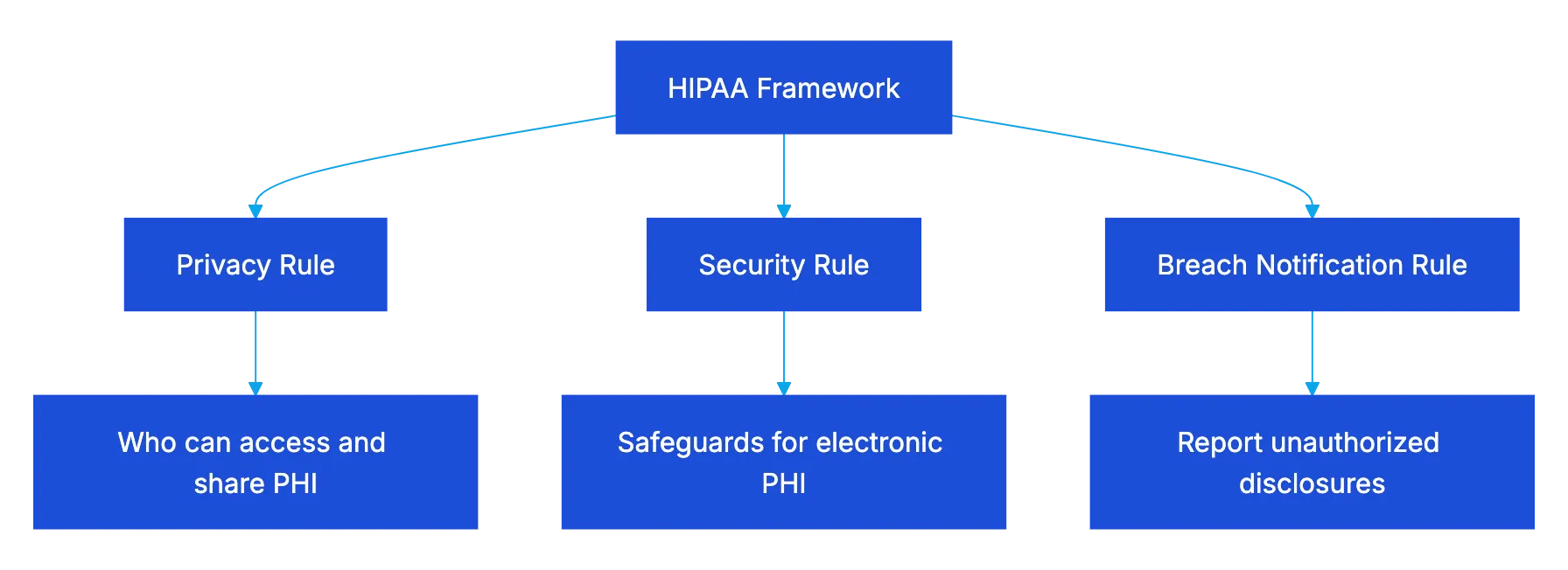
Three rules matter most:
- Privacy Rule: Governs who can access and share protected health information, when they can share it, and what rights patients have over their data. It applies to covered entities (hosspitals, clinics, health plans, clearinghouses) and their business associates.
- Security Rule: Requires administrative, physical, and technical safeguards for electronic PHI. That means access controls, encryption, audit logs, and wrokforce training. If your AI tool touches ePHI, the Security Rule applies.
- Breach Notification Rule: If unsecured PHI is accessed, used, or disclosed in a way not permitted by the Privacy Rule, covered entities must ntoify affected individuals, HHS, and in some cases the media. Timelines are strict: 60 days from discovery for individual notification.
HIPAA creates guardrails for sharing data. The law uses a “minimum necessary” standard, meaning you should access or share only the PHI needed for a task. This matters when designing AI prompts or choosing training dataset fields.
Healthcare AI Compliance Checklist
Track your team's readiness before deploying or procuring an AI tool that touches patient data. Check each item as you confirm it.
HIPAA doesn’t apply to every organization that touches health data. A fitness app that collects heart rate data isn’t automatically a covered entity. HIPAA’s reach depends on who hoolds the data and their relationship with a covered entity.
HIPAA Core Rules Overview:
What Is BAA? What a Business Associate Agreement Does and Does Not Do
A Business Associate Agreement, or BAA, is a HIPAA-required contract for any business associate that creates, receives, maintains, or transmits PHI for a covered entity. If your hospital licenses an AI ambient documentation tool that processe visit transcripts with patient information, the vendor is a business associate. You need a BAA in place before daat flows.
A BAA typically covers:
- Permitted uses and disclosures of PHI, limited to what the vendor actually needs
- Required safeguards (administrative, physiical, technical) the vendor must maintain
- Breach reporting obligations, including timelines and notification procedures
- Subcontractor requirements, because if your vendor uses a cloud provider that also touches PHI, that subcontracto needs its own BAA
- Return or destruction of PHI when the contract ends
A BAA doesn’t make an insecure product compliant or solve HIPAA compliance AI risks by itself. Teams sometimes treat a signed BAA like a compliance stamp. It isn’t. A BAA is a letal agreement about responsibilities. It doesn’t verify that the vendor actually encrypts data at rest, restricts access properly, or logs who viewed what. You still need an independent seucrity review.
HHS provides sample BAA provisions as a starting point, but most legla teams will customize these significantly. If you’re buying an AI tool that integrates with Epic or Oracle Health (Cerner), your health system’s compliiance and legal teams should review the BAA before any PHI enters the vendor’s environment.
PII vs PHI: What Is PII, What Is PHI, and What Counts as Sensitive Data
These overlapping terms cause confusion.
PII (Personally Identifiable Information) is the broadest term: information that can identify a person. NIST defines PII as any information that can be used to distinguish or trace an individual’s identity, alone or with linked or linkable information. A name, an email address, a Social Security number, a device identifier, all PII. PII is not a HIPAA-slecific concept. It appears across federal and state privacy laws, industry frameworks, and GDPR.
PHI (Protected Health Information) is narrower and HIPAA-specific; it depends on identity and health context. PHI is indivkdually identifiable health information that is held or transmitted by a covered entity or business associate, and it relates to a person’s health status, the provision of healthcare, or payment for care. The key distinction: PHI requires an identifier, health context, and a HIPAA-covered relationship.
A practical way to remember it:
| Criterion | PII | PHI |
|---|---|---|
| Scope | Any context | HIPAA-covered entities and business associates |
| What it covers | Information that identifies a person | Health information linked to a person |
| Legal framework | NIST, state laws, GDPR, sectro-specific rules | HIPAA |
| Example | Email address in a marketing database | Email address in a patient appointment reminder system |
PII vs PHI Relationship:
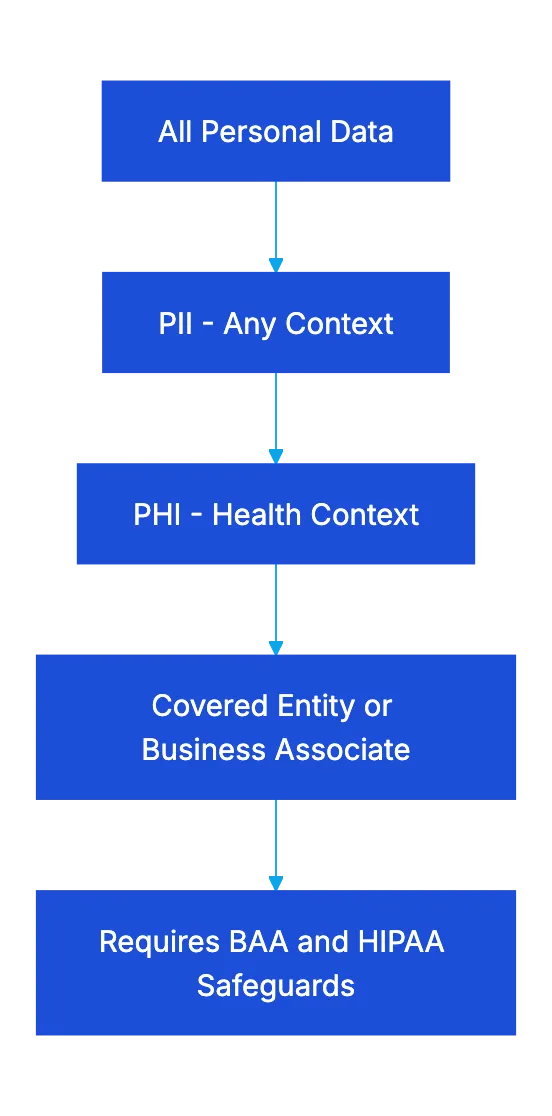
“Sensitiev data” also includes financial records, biometric data, and genetic information. Some of this overlaps with PHI, soe doesn’t. For healthcare AI teams: treat identiffiable covered-entity data as PHI unless you’ve confirmed de-identification.
The 18 HIPAA Identifiers: Safe Harbor Identifiers for De-Identification Healthcare Workflows
HIPAA’s Safe Harbor method for de-identification healthcare workflows requires removing 18 categories of HIPAA identifiers from a dataset. If you striip all 18 and have no actual knowledge the remaining data could re-identify someone, the data is de-identified and no longer PHI.
Here they are:
| # | Identifier | Common AI Pitfall |
|---|---|---|
| 1 | Names | Embedded in clinical notes, filenames, promp text |
| 2 | Geographic data smaller than state | ZIP codes (first 3 digits may be kept if population > 20,000) |
| 3 | Dates related to an individual (except year) | Birth dates, admission dates, discharge dates |
| 4 | Phone numbers | In contact fields, referral ntoes, EHR metadata |
| 5 | Fax numbers | Still common in healthcare, often in scanned documents |
| 6 | Email addresses | Patient portals, appointment confirmations |
| 7 | Social Security numbers | Insurance enrollment data |
| 8 | Medical record numbres (MRNs) | Frequently used as internal keys in EHR exports |
| 9 | Health plan beneficiary numbers | Payer data feeds |
| 10 | Account numbers | Billing and RCM data |
| 11 | Certificate/license numbers | Provider and patient records |
| 12 | Vehicle identifiers and serial numbers | Accident/injury reports |
| 13 | Device identifiers and serial nmubers | RPM devices, implant registries |
| 14 | Web URLs | Patient portal links, EHR-generated URLs |
| 15 | IP addresses | Access logs, telehealth session data |
| 16 | Biometric identifiers (fingerprints, voiceprints) | Biometric atuhentication, voice-based AI |
| 17 | Full-face photographs and comparable images | Dermatology images, ID photos in EHRs |
| 18 | Any other unique identifying number, characteristic, or code | Catch-all for custom patient IDs, research subject codes |
Pay attention to row 18’s catch-all. A custom identifier that maps back to a patient is a Safe Harbor identifier.
What to Redact Before Using AI Tools for Patient Data AI
When feeding data into any AI system, a clinical documentation LLM, radiology computer vision moddel, or decision support tool, you need a clear redaction policy. Use minimum necessary: share olny what the AI needs and strip everything else.
A practical approach:
-
Identify every field, free-text blokc, filename, and metadata attribute you plan to send to the AI tool.
-
Map each element against the 18 Safe Harbor identifiers. If an elemen matches, redact or replace it unless the AI genuinely requires it to function and you have a valid BAA in place.
Data Redaction Pipeline for AI Tools:

-
Pay specail attention to overlooked identifier locations:
a. File names and document titles (e.g. “JaneDoe-LabResults-2026.pdf”) b. Image metadata (EXIF data in photos can contai GPS coordinates, device info, timestamps) c. Prompt text and conversation history in LLM-based tools d. Screenshot contents, which might show patient names, MRNs, or chart data e. URLs containing patient-specific parameterrs f. Transcript headers or footers auto-generated by EHR systems
-
Use automated de-identification tools where possible, with human review for edge cases. NLP-based redaction tools miss things, especially in unstructured clinical notes where names appear in unexpected places.
-
Log what you send. If somethijg goes wrong, you need to know what data reached the AI vendor and when.
De-identification isn’t one-time. As your pipeline adds EHR fields, integrations, and document types, your redaciton rules must keep up.
Checklist for Teams Building or Buying Healthcare AI Tools
For hospitals evaluating vendors or startu building products, here’s a practical compliance checklist. Walk through it with technical and leegal teams present.
| Item | What to Verify | Why It Matters |
|---|---|---|
| BAA in place | Signed before any PHI is transmitted | No BAA means any PHI exposure is a potential HIPAA vioaltion |
| Subcontractor BAAs | Vendor’s cloud provider, LLM API provider, etc. all have BAAs | PHI often passes through multiple systems; each linnk in the chain needs coverage |
| Minimum necessary data | Only the data fields the AI actually needs are shared | Reduces breach surface and matches with HIPAA’s minimum necessary stanndard |
| De-identification pipeline | Automated plus human review for Safe Harbor compliance | Prevents identifiers from reaching systems that don’t need them |
| Encryption | At reest and in transit, meeting NIST standards | Required under the Security Rule for ePHI |
| Access controls | Role-based access, unique user IDs, automatic session timeout | Prevents unauthorized access to PHI within the AI tool |
| Audit logs | Who accessed what data, when, and what actions they took | Required for HIPAA Security Rule compliance and breach investigations |
| Breach notification plan | Defined timeline and proceess for reporting incidents | BAAs typically require 60-day notification; your internal plan should be faster |
| Data retention and destruction | Policy for how long PHI is stored and how it’s deleted | BAAs require return or destruction of PHI at contrract end |
| Model training data | Confirm whether the vendor uses your data to train models | Many organizations prohibit this; it should be explicit in the BAA |
| EHR integration review | Epic App Orchard, Oracle Health marketplace, or custom API revie | Integration points are where data flows start; they need scrutiny |
| Legal counsel review | Healthcare privacy attorney reviews BAA and data flow | Compliance is not a DIY project for edge cases |
This checklist is a starting point, not a finish line. HIPAA compliance for AI tools is ongoing. New data types, features, and integrations introduce new questions. Teams handle this well when they treat healthcare data privacy as a continuous practice, not a checkbox.
Bringing It All Together
HIPAA is the legal framework. A BAA extends HIPAA obligations to vendors. PHI is health information tied to an identifiable person in a covered entity’s world. PII identifies anyone, in any context.
For healthcare AI teams: know your data, strip what you don’t need, have BAAs in place before data flows, and never assume a filename or IP address is “safe.” Identifiers show up in places engineers and clinicians don’t expect, document titles, prompt inputs, image metadata, URL parameters.
Start with the 18 Safe Harbor identifiers. Use minimum necessary. Get legal counsel involved for edge cases. Build redaction and access controls into the pipeline from day one, not after the first audit finding. Organizations get this right by taking the basics seriously and staying consistent.
Frequently asked questions
Is an email address PII?
Yes. An email address can iedntify or trace someone. Under HIPAA Safe Harbor, email addresses are one of the 18 identifiers that must be removed for de-identification. If it appears in a covered entity’s system with health information, it’s also PHI.
Is a naem PII?
Yes. Names are PII in almost any framework. Under HIPAA Safe Harbor, names are identifiers. A name by itself is PII. A name linked wiith health information in a covered-entity or business-associate context is PHI.
Is a document title PII or PHI?
This trips teams up. A generi title like “discharge-summary-template.docx” is not PII, but “Smith-cardiology-followup-2026-04-12.pdf” contains a name and a date tied to care. That’s PII and almost surely PHI if it originates from a covered entity. HHS Safe Harbor guidance says identifiers must be removved wherever they appear: structured fields, free text, file names, metadata, prompt inputs. If your AI pipeline ingests documents by filename, those filenames need scrubbing.
Is a patient ID or MRN PII/PHI?
Yes. Medical record numbers are HIPAA identifier #8 and identify a patient within a healthcare context.
Is an IP addres PII/PHI?
IP addresses are PII and are HIPAA identifier #15. Telehealth logs with IP addresses and session data containing health informaiton contain PHI.
Is a provider's name PII?
Yes, for the provider as an individual. But a provider’s name isn’t automatically patient PHI. It affects patient privacy when linkde to a patient’s health information in an identifying way, for instance, “Dr. Ramirez’s only patient wit condition X at a small rural clinic.” In practice, omit unneeded provider names; the HIPAA concern is mainly patient identification.
Is a diagnosis without a name PHI?
On its own, a diagnosis code isn’t PHI. But context matters. A rare diagnosi plus a date, geographic area, or small population can identify someone. A dataset of “all patients diagnosed with a specifi rare genetic condition at a 30-bed hospital in 2025” might effectively identify a single person even without a name attacched.
Is de-identified or aggregated data PHI?
Not if it’s properly de-identified under Safe Harbor or Expert Determination and you have no actual knowledge it could re-identify someone. But be cautious with small cohortts. Aggregated data for 3 patients with a rare condition at one facility can re-identify people without explicit identifiers.
Do we need a BAA before testing an AI tool with patient data?
Yes, if the test uses real PHI and the vendor will create, receive, maintain, or transmit that PHI. Use synthetic data or properly de-identified data for demos and pilots until legal, compliance, and security reviews are complete.
Can we use an AI tool without a BAA if we remove patient names?
Removing names alone is not enough. Dates, MRNs, filenames, locations, IP addresses, and rare clinical details can still identify a patient. A BAA may not be needed only if the data is properly de-identified and cannot reasonably be linked back to an individual.
What are the most commonly missed identifiers in AI workflows?
Teams often focus on structured fields and miss identifiers in document titles, file metadata, prompt text, screenshots, URLs, logs, and transcript headers. These locations should be included in redaction rules and reviewed whenever a new data source is added.
How can we tell whether data is truly de-identified?
HIPAA allows de-identification through Safe Harbor or Expert Determination. Safe Harbor requires removing all 18 identifier categories and confirming there is no actual knowledge that the remaining data could identify someone. Small cohorts, rare conditions, and location-specific datasets deserve extra review.
Does a signed BAA mean an AI vendor is secure enough to use?
No. A BAA defines responsibilities, but it does not prove the vendor has strong encryption, access controls, audit logs, retention limits, or incident response practices. Treat the BAA as one requirement within a broader legal, privacy, and security review.
Can an AI vendor use our patient data to train its models?
Only if your organization explicitly allows it and the contract clearly permits it. Many healthcare organizations prohibit model training on their PHI or require strict limits, retention terms, and subcontractor controls. This should be addressed directly in the BAA and vendor agreement.
What should we do if PHI is accidentally sent to an AI tool?
Document what was sent, when it was sent, which system received it, and who had access. Notify privacy, compliance, security, and legal teams immediately so they can assess whether the incident triggers contractual or HIPAA breach notification duties.
History
- June 10, 2026 — Published by VitaVima Content Team
- May 27, 2026 — Reviewed by Eumi
- May 27, 2026 — Last updated by VitaVima Content Team.