HRV in Pharma: Wearables and Digital Biomarkers
Table of Contents
- Introduction
- What HRV Measures and Why It Matters in HRV Pharma Research
- How Heart Rate Variability Pharma Studies Collect Wearable HRV
- Where HRV Pharma Research and Digital Biomarkers Add Value
- Confounders and Evidence Limitations
- Turning Wearable HRV Data Into Defensible Digital Biomarkers
- HRV Clinical Trials, Statistics, and Remote Patient Monitoring
- Regulatory, Privacy, and EHR Integration in HRV Pharma Programs
- Conclusion
- Introduction
- What HRV Measures and Why It Matters in HRV Pharma Research
- How Heart Rate Variability Pharma Studies Collect Wearable HRV
- Where HRV Pharma Research and Digital Biomarkers Add Value
- Confounders and Evidence Limitations
- Turning Wearable HRV Data Into Defensible Digital Biomarkers
- HRV Clinical Trials, Statistics, and Remote Patient Monitoring
- Regulatory, Privacy, and EHR Integration in HRV Pharma Programs
- Conclusion
Introduction
HRV pharma research can track autonomic changes without daily clinic visits. A wearable HRV sensor can collect beat-to-beat timing during sleep, rest, or ordinary activity. Researchers can examine whether patterns change with treatment, disease progression, pain, stress, or toxicity.
Wearable HRV collection is complex. Heart rate variability is affected by breathing, posture, sleep, age, medication, illness, exercise, alcohol, and sensor errors. A consumer device may also calculate a different measure from a clinical electrocardiogram. Therefore, most heart rate variability pharma programs use HRV as an exploratory or supportive measure, not proof of treatment efficacy.
TL;DR: This guide explains how wearable HRV and digital biomarkers support remote patient monitoring and drug research within measurement, validation, and regulatory limits:
- How HRV is measured
- Where it can help drug research
- What evidence is available
- How to validate devices and endpoints
- What sponsors should address before regulatory use
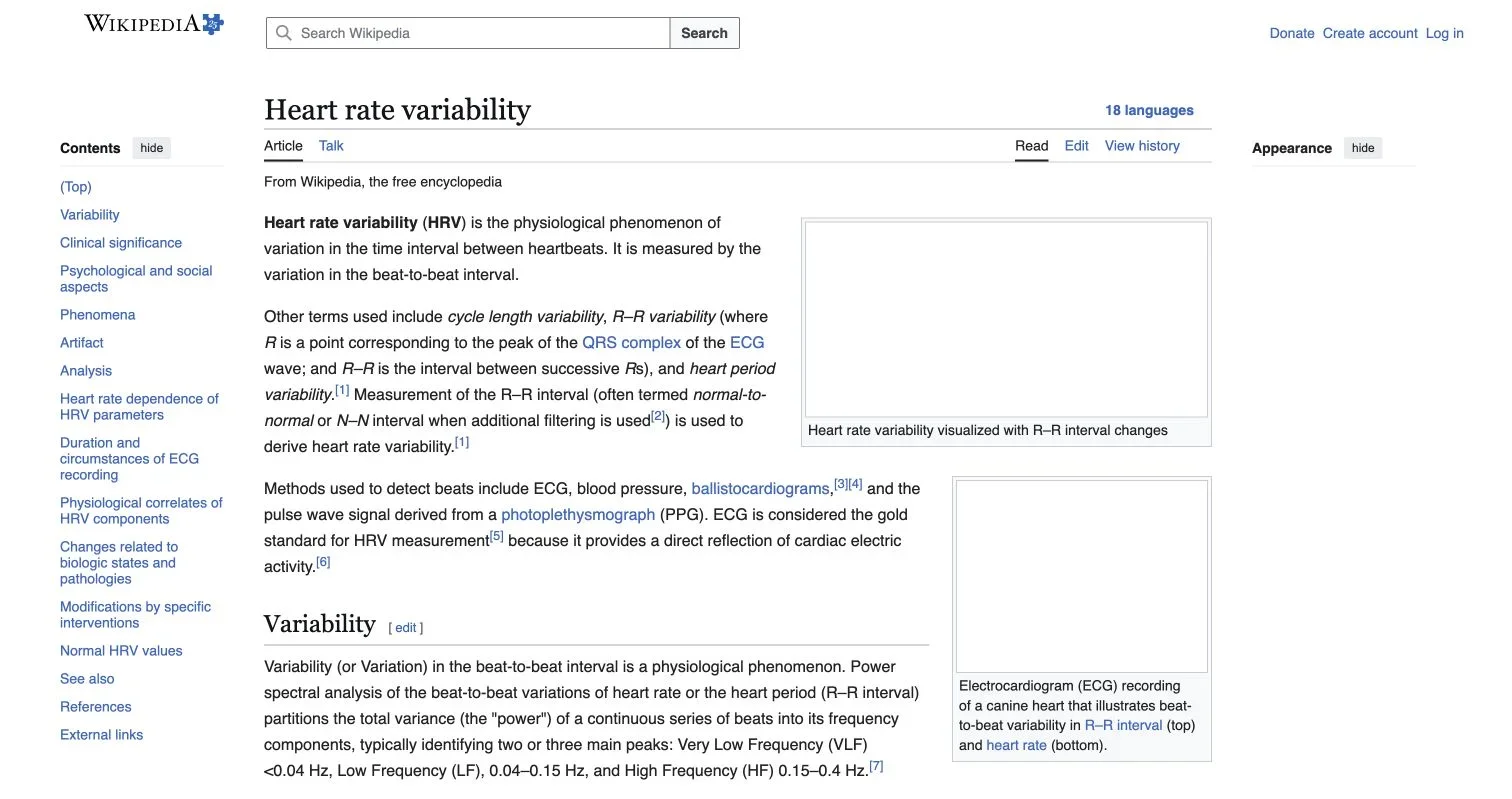
Source page reviewed in Chrome during article research. Follow the image link for the current page.
What HRV Measures and Why It Matters in HRV Pharma Research
Heart rate variability describes variation in the time between consecutive heartbeats. At 60 beats per minute, intervals do not necessarily last exactly one second. One interval might be 859 milliseconds and the next 793 milliseconds. These differences reveal cardiac rhythm and autonomic regulation.
The current Wikipedia overview of heart rate variability provides a useful visual introduction and describes electrocardiography, or ECG, as the reference method because it records cardiac electrical activity directly. This basic explanation is suitable, but clinical decisions and trial design require validated methods and peer-reviewed evidence.
Common HRV measures include:
| Measure | Plain-language meaning | Typical use |
|---|---|---|
| SDNN | Overall variation in normal beat intervals | Longer recordings and general variability |
| RMSSD | Short-term changes between successive intervals | Resting or overnight parasympathetic activity |
| HF power | Variation within a higher-frequency band | Respiratory and parasympathetic influences |
| LF power | Variation within a lower-frequency band | Mixed physiological influences |
| LF/HF ratio | Ratio of two frequency bands | Historically used as an autonomic balance measure |
Interpret the LF/HF ratio cautiously. Although often described as the balance between sympathetic and parasympathetic activity, it reflects more complex physiology. A single ratio cannot precisely measure stress or autonomic health.
In HRV pharma studies, ask not whether a number is “good,” but whether a predefined measure changes reliably under controlled conditions in the intended population and relates to treatment or clinical status.
How Heart Rate Variability Pharma Studies Collect Wearable HRV
HRV begins with accurate detection of individual beats. ECG records the heart’s electrical signal and identifies R-peaks. Photoplethysmography, or PPG, shines light into the skin and detects pulse-related blood-volume changes. Watches and rings commonly use PPG, but pulse intervals differ from ECG-derived R-R intervals.
| Approach | Main strength | Main limitation | Suitable role |
|---|---|---|---|
| Multi-lead clinical ECG | Detailed reference signal | Clinic-based and burdensome | Diagnostic assessment and validation reference |
| Wearable ECG patch | Long recordings in daily life | Adhesive tolerance and logistics | Ambulatory research and safety monitoring |
| ECG chest strap | Good beat timing during controlled use | Participant burden and motion artifacts | Short resting tests and device validation |
| Wrist or ring PPG | Comfortable for repeated remote collection | Motion, perfusion, skin contact, and algorithm effects | Overnight or resting exploratory measurement |
A 2018 review of 18 wearable HRV validation studies found very good to excellent agreement with ECG-derived HRV at rest, but declining accuracy as exercise intensity increased. A later meta-analysis covering 23 studies and 301 effects found a small overall difference between portable devices and ECG, with substantial heterogeneity of I² = 78.6%. A device is not “validated for HRV” without a specified metric, population, activity, recording duration, and reference method.
A defensible collection protocol usually defines:
- Whether measurement occurs during sleep, quiet rest, or free-living activity.
- The minimum recording duration and acceptable wear time.
- The exact HRV metric, units, filtering rules, and analysis window.
- How ectopic beats, atrial fibrillation, gaps, and motion artifacts are handled.
- Whether raw intervals, processed outputs, or both are retained.
Five-minute resting recordings and overnight summaries answer different questions and should not be pooled.
Where HRV Pharma Research and Digital Biomarkers Add Value
HRV’s strongest near-term pharma use is as a repeated physiological measure complementing established clinical outcomes. Frequent remote collection can reveal trajectories missed by monthly clinic visits. It can also reduce travel for ill, distant, or mobility-limited participants.
Potential applications include:
- Pharmacodynamic research: detecting whether treatment is associated with an autonomic response
- Safety monitoring: identifying unusual changes that may justify review alongside symptoms, ECG findings, or vital signs
- Disease monitoring: studying changes associated with pain, fatigue, infection, sleep disruption, or worsening illness
- Participant stratification: looking at whether baseline autonomic patterns identify groups with different outcomes
- Adherence and context: interpreting physiological changes alongside activity, sleep, and medication timing
Studies show both promise and limits. A randomized HRV clinical trial of pregabalin in painful diabetic neuropathy enrolled 40 people, with 29 completing four-week assessments. Several frequency-domain HRV measures improved versus placebo but did not correlate with improved pain, anxiety, or quality of life. A physiological response does not necessarily benefit patients.
A 2025 multisite study embedded in a randomized trial collected sequential 24-hour HRV measurements from adolescents and young adults receiving hematopoietic cell transplantation. Researchers examined HRV trajectories and patient-reported anxiety, depression, resilience, hope, and quality of life. This exploratory use connects digital biomarkers with participant-relevant outcomes without assuming HRV can replace them.
Another example followed 66 people for 12 weeks after starting a GLP-1 receptor agonist. Wearables captured resting heart rate, HRV, activity, and sleep to study cardiovascular changes under real-world conditions. The observational design identifies patterns but provides less causal evidence than a randomized drug trial.
Confounders and Evidence Limitations
Many processes affect HRV, making it sensitive to change but difficult to interpret. Ordinary behavioral or health changes can mimic or hide a treatment signal.
A 2024 review grouped HRV influences into physiological factors, diseases, modifiable lifestyle factors, and external conditions. It reported associations with age, sex, circadian rhythm, cardiovascular and psychiatric disease, alcohol use, body weight, physical activity, heat, noise, and shift work. Breathing rate and posture can alter short recordings within minutes.
| Confounder | How it can affect interpretation | Practical control |
|---|---|---|
| Time of day | HRV follows a circadian pattern | Measure within consistent time windows |
| Posture | Supine and seated readings differ | Use one documented position |
| Breathing | Rate and depth affect respiratory variation | Record respiration or standardize instructions |
| Exercise | Acute activity changes HRV and increases artifact | Set a pre-measurement rest period |
| Medication | Beta-blockers and other drugs alter rhythm | Record dose, timing, and changes |
| Illness and pain | Acute symptoms can reduce HRV | Collect symptoms and relevant clinical events |
| Sleep and alcohol | Both can alter overnight results | Use diaries or companion digital measures |
| Arrhythmia | Irregular beats may make standard metrics misleading | Apply prespecified clinical and signal-quality review |
Every heart rate variability pharma report should present three limitations.
First, association is not validation: lower HRV is associated with adverse outcomes in several diseases, but raising it does not necessarily improve health. Second, group averages can conceal individual differences, making within-person change more interpretable than a universal “normal” range. Third, results from healthy adults at rest may not transfer to older patients, people with arrhythmias, darker or lighter skin tones, impaired circulation, tremor, or free-living movement.
Missingness is another source of bias. Participants may remove devices when sick, uncomfortable, or hospitalized, so treating gaps as random can make the treatment group appear healthier.
Turning Wearable HRV Data Into Defensible Digital Biomarkers
The FDA-NIH BEST terminology defines a biomarker as a measured characteristic indicating a biological process, disease process, or response to an exposure or intervention. It distinguishes biomarkers from direct measures of how a person feels, functions, or survives.
This prevents a common HRV pharma mistake. An HRV measure may be a digital biomarker but not an acceptable clinical or surrogate endpoint. Required evidence depends on its context of use: the measure’s exact purpose and circumstances.
Sponsors can build evidence in this order:
- Define the concept. State whether the intended signal concerns autonomic response, recovery, safety, prognosis, or another concept.
- Verify the sensor. Confirm that the hardware detects beat or pulse intervals accurately under expected conditions.
- Validate the algorithm. Compare the final metric with an appropriate ECG reference, using the intended firmware and processing pipeline.
- Test usability. Determine whether participants can wear, charge, synchronize, and troubleshoot the device.
- Establish analytical validity. Quantify agreement, repeatability, artifact rates, data loss, and sensitivity to software changes.
- Establish clinical validity. Show that the measure relates to the target disease, treatment response, or outcome in the intended population.
- Demonstrate clinical meaning. If HRV will support an efficacy claim, establish what amount of change matters to patients or predicts a recognized outcome.
Validation should assess error, not just correlation: two devices can trend together yet classify participants differently. Useful analyses may include Bland-Altman limits of agreement, concordance, mean absolute error, test-retest reliability, and predefined acceptable-error thresholds.
Device updates require control because new sensors, firmware, sampling rates, or artifact algorithms can change the endpoint. Sponsors should track every version and conduct bridging studies for changes that could affect key data.
HRV Clinical Trials, Statistics, and Remote Patient Monitoring
In HRV clinical trials, the measure can be used as an exploratory outcome, secondary endpoint, safety signal, enrichment variable, or, in rare cases, part of a primary endpoint strategy. Most current uses belong in the first two categories because clinical meaning and cross-device comparability remain uncertain.
| Trial role | Evidence burden | Sensible use today |
|---|---|---|
| Exploratory measure | Moderate | Learn about trajectories and generate hypotheses |
| Pharmacodynamic biomarker | Moderate to high | Show biological response to treatment |
| Secondary endpoint | High | Support efficacy or safety interpretation |
| Surrogate endpoint | Very high | Substitute for a direct clinical outcome only with strong evidence |
| Clinical alert | High and operational | Trigger review under a tested monitoring protocol |
Before database lock, the statistical analysis plan should define the endpoint, baseline, aggregation window, minimum valid data, artifact treatment, multiplicity, estimand, intercurrent events, and missing-data sensitivity analyses. Searching many HRV features after viewing treatment assignments invites false positives.
Wearable HRV monitoring also requires a clear response plan. Low HRV alone should rarely trigger an urgent alert because consumer readings are noisy and baselines vary. A safer design combines persistent HRV changes with symptoms, resting heart rate, rhythm, temperature, oxygen saturation, or another clinically interpretable measure. The protocol must specify who reviews alerts, when, how quickly, and what happens if participants cannot be reached.
The FDA’s December 2023 guidance on digital health technologies addresses remote data acquisition in medical-product investigations. It recommends attention to technology selection, verification and validation, participant training, data management, risk, and record retention. The agency notes that remote tools may improve convenience and access without reducing sponsor responsibility for reliable trial data.
Regulatory, Privacy, and EHR Integration in HRV Pharma Programs
Regulators evaluate the entire wearable HRV system, not just the sensor. The system includes the sensor, app, firmware, cloud transfer, artifact filtering, endpoint algorithm, instructions, support, and data repository.
The European Medicines Agency’s digital-methodology Q&A asks sponsors to define context of use and address accuracy, reliability, sensitivity to change, compliance, clinical relevance, computer-system validation, audit trails, missing data, and software changes. EMA also recommends early exploratory testing and bridging evidence if key studies use technology different from earlier versions.
A practical readiness checklist is:
| Item | What to check | Why it matters |
|---|---|---|
| Endpoint specification | Metric, window, units, posture, and algorithm version | Prevents silent differences across sites |
| Device evidence | Validation in the target population and setting | Bench or healthy-volunteer results may not transfer |
| Data provenance | Sensor-to-analysis audit trail and timestamps | Supports inspection and reconstruction |
| Change control | Firmware, app, and algorithm version history | Updates can change endpoint values |
| Missing-data plan | Reasons, thresholds, and sensitivity analyses | Wear time may be related to health status |
| Participant support | Training, replacement, charging, and connectivity | Reduces avoidable data loss |
| Clinical response | Alert ownership and escalation rules | Prevents unmonitored safety signals |
| Privacy controls | Consent, access, retention, encryption, and vendors | Limits inappropriate disclosure and security risk |
HIPAA covers consumer wearable records only when they are protected health information handled by covered entities or business associates. For covered research, HHS explains that identifiable health information may be used with participant authorization or under defined waiver pathways. Sponsors must also consider consent, IRB oversight, state laws, contracts, and international privacy rules.
Rather than flood Epic or Oracle Health/Cerner charts with second-by-second intervals, hospitals should send reviewed summaries, trends, and actionable alerts. HL7 FHIR Observation resources can represent measurements and their metadata, while raw research signals remain in a governed repository linked through participant, device, time, and study identifiers.
Conclusion
HRV in pharma can provide frequent, low-burden information about autonomic and physiological change. Its best current role is exploratory, pharmacodynamic, or supportive. It cannot directly measure stress, recovery, or clinical benefit without supporting evidence.
A credible heart rate variability pharma program needs a narrow context of use. It standardizes conditions, validates the device-and-algorithm system against ECG, records confounders, preserves provenance, and plans for artifacts and missing data. It keeps digital biomarkers separate from patient-centered outcomes unless a validated relationship connects them.
Begin new studies with a small feasibility phase in the intended population. Measure adherence, signal quality, device error, and participant burden before making HRV central to a protocol. That early work is less thrilling than a continuous-data dashboard, but it makes later data interpretable.
Frequently asked questions
Which HRV metric should a pharma study use?
The choice should match the study’s context of use, recording conditions, and intended physiological concept. RMSSD may suit short resting or overnight assessments, while SDNN is often more appropriate for longer recordings; metrics from different windows should not be treated as interchangeable.
Can a consumer smartwatch or ring provide trial-quality HRV data?
Potentially, but only after the complete device-and-algorithm system is validated for the intended population, activity, metric, and recording duration. Accuracy demonstrated in healthy people at rest does not establish suitability during movement, illness, or treatment.
Should wearable HRV be compared with ECG before a study begins?
Yes, when HRV will support trial interpretation or decision-making. Validation should assess agreement, repeatability, artifacts, and data loss against an appropriate ECG reference rather than relying only on correlation.
How can researchers reduce the effect of HRV confounders?
Protocols should standardize factors such as time of day, posture, breathing instructions, and pre-measurement rest. Researchers should also record medication timing, illness, pain, sleep, alcohol, exercise, and rhythm abnormalities so these factors can be considered during analysis.
Can a change in HRV show that a treatment benefits patients?
Not by itself. An HRV change may indicate a physiological or pharmacodynamic response, but patient benefit must be established through validated clinical outcomes or strong evidence linking the biomarker to outcomes that matter to patients.
How should missing wearable HRV data be handled?
Studies should document why data are missing, set minimum valid-wear thresholds, and prespecify sensitivity analyses. Missingness should not automatically be treated as random because participants may stop wearing devices when they are sick, uncomfortable, or hospitalized.
Should a low HRV reading trigger a clinical alert?
A single low reading usually should not trigger urgent action because HRV varies between individuals and wearable measurements can be noisy. Safer monitoring protocols use persistent changes from a personal baseline alongside symptoms and other clinically interpretable measures, with clear review and escalation responsibilities.