Zanus AI for Hospitals: Evaluation and Buyer Guide
Table of Contents
- Zanus AI for hospitals: evaluating private hospital AI
- What is Zanus AI for healthcare and on-premises AI?
- Where Zanus AI for hospitals might fit in healthcare AI workflows
- EHR integration, Epic integration, and imaging questions for hospital AI
- Healthcare AI evidence and clinical governance for Zanus AI for hospitals
- HIPAA-ready AI and on-premises AI security require more than location
- Build a measured Zanus AI for healthcare pilot, not a broad rollout
- Metrics that reveal whether the pilot works
- Zanus AI for hospitals buyer checklist
- Conclusion: buy the workflow, then consider the platform
- Zanus AI for hospitals: evaluating private hospital AI
- What is Zanus AI for healthcare and on-premises AI?
- Where Zanus AI for hospitals might fit in healthcare AI workflows
- EHR integration, Epic integration, and imaging questions for hospital AI
- Healthcare AI evidence and clinical governance for Zanus AI for hospitals
- HIPAA-ready AI and on-premises AI security require more than location
- Build a measured Zanus AI for healthcare pilot, not a broad rollout
- Metrics that reveal whether the pilot works
- Zanus AI for hospitals buyer checklist
- Conclusion: buy the workflow, then consider the platform
Zanus AI for hospitals: evaluating private hospital AI
Installing private AI hardware inside a hospital while keeping sensitive data off public clouds sounds simple. Buying hospital AI is not. A hospital must determine what the system does, how it connects to clinical systems, whether its outputs are reliable, and who is responsible when something goes wrong.
The vendor’s current website presents Zanus AI for healthcare as an on-premises platform for patient records, diagnostic work, and clinical documentation. Those are vendor claims, not evidence of a completed Epic integration, FDA authorization, or better patient outcomes. This guide separates verified claims from unanswered questions. TL;DR: Test Zanus AI for healthcare in one narrow, low-risk workflow and demand evidence before expanding. This guide covers use cases, EHR and imaging integration, HIPAA, clinical evidence, security, pilot design, and procurement.
- Verified starting point: Zanus AI markets private, locally operated AI hardware and software.
- Still to verify: specific hospital deployments, interfaces, regulatory status, and measured clinical results.
- Buying principle: approve one narrow workflow before considering a hospital-wide platform.
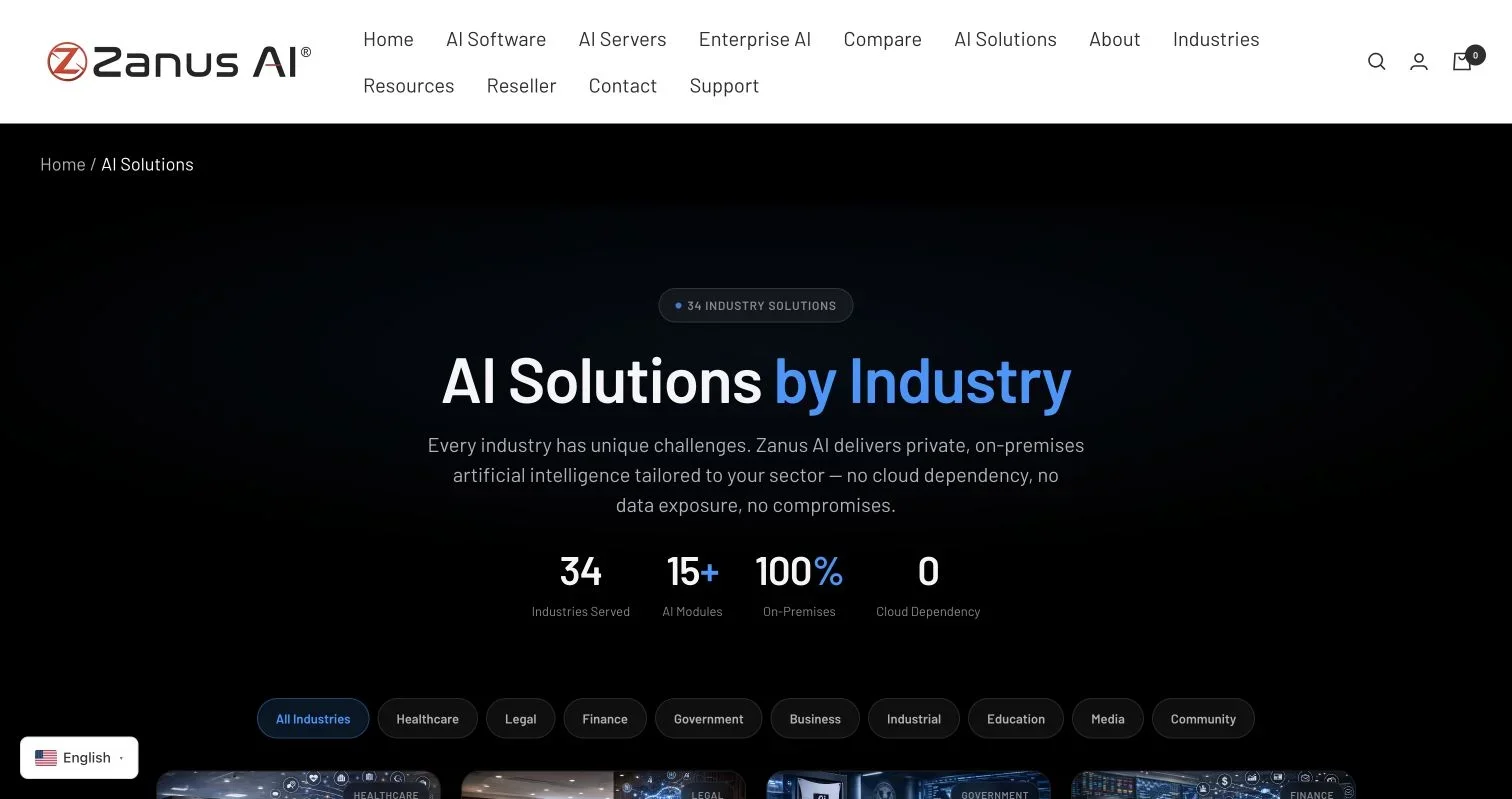
Source page reviewed in Chrome during article research. Follow the image link for the current page.
What is Zanus AI for healthcare and on-premises AI?
The company spells its name Zanus AI, without the macron sometimes used in “Zanūs AI.” Its AI Solutions page says the company provides physical AI servers, an operating system, and more than 15 software modules. It describes the platform as fully on-premises AI with no cloud dependency and identifies healthcare and pharmaceutical organizations among 34 target industries.
For healthcare, the page describes HIPAA-ready AI and mentions patient records, diagnostics, clinical documentation, drug discovery, and clinical-trial analysis. It does not publish enough detail on that page to confirm named EHR integrations, supported data standards, FDA clearances, peer-reviewed clinical studies, or production outcomes from hospitals. Buyers should treat these as intended uses, not validated capabilities.

Source-page visual accompanying the healthcare listing. Product claims should be confirmed in technical and contractual documentation.
| Vendor statement | What a hospital should request |
|---|---|
| Private, on-premises AI | Architecture diagram showing every data flow and external connection |
| “HIPAA-ready” healthcare use | Security controls, BAA position, risk assessment evidence, and responsibility matrix |
| Patient records and documentation | Supported FHIR, HL7 v2, document, terminology, and write-back functions |
| Diagnostic imaging | DICOM support, intended use, validation data, and applicable FDA authorization |
| More than 15 modules | Versioned module list with dependencies, limitations, and support terms |
Where Zanus AI for hospitals might fit in healthcare AI workflows
The safest early uses of Zanus AI for hospitals are administrative or assistive, keeping a human between the model and actions affecting care, payment, or patient records. Higher-risk uses require stronger evidence and, in some cases, medical-device review.
| Use case | Possible hospital workflow | Main risk to test |
|---|---|---|
| Clinical documentation | Create a draft note from a transcript for clinician review | Missing facts, invented findings, consent, and note bloat |
| Record search | Find policies, discharge instructions, or facts within approved documents | Stale sources and answers without traceable citations |
| Revenue cycle management | Suggest codes or summarize denial reasons for billing staff | Upcoding, payer-rule errors, and weak audit trails |
| Patient engagement | Draft portal replies or explain approved instructions in plain language | Unsafe advice, language errors, and delayed escalation |
| Remote patient monitoring | Summarize incoming readings and place cases into a review queue | False reassurance, alert overload, and missing data |
| Imaging support | Prioritize or analyze studies within a defined radiology workflow | Diagnostic error, model drift, and regulatory status |
| Life-science research | Search protocols or summarize literature for human researchers | Unsupported scientific claims and incomplete provenance |
One practical use case is drafting discharge instructions. Zanus AI for healthcare could receive an approved medication list and care plan, prepare patient-friendly text, and return a draft to a nurse. The pilot should prohibit autonomous sending. Staff would measure factual corrections, reading level, translation quality, and time saved.
Another is denial management. The system could summarize payer correspondence and locate the relevant internal policy. Billing specialists would still decide whether to appeal. This workflow tests document retrieval without allowing the model to alter a claim automatically.
EHR integration, Epic integration, and imaging questions for hospital AI
A private hospital AI server does not automatically integrate with an EHR. Zanus AI for hospitals must exchange information with systems that already control identity, orders, results, notes, images, and audit records. The reviewed vendor page names no Epic or Oracle Health integration, so buyers should request a live demonstration with their EHR version and workflow.
SMART App Launch provides a standard way for an authorized application to launch inside or outside an EHR and access FHIR data. It does not guarantee every desired field, write-back operation, or event. Hospitals may also need HL7 v2 messages, DICOM for imaging, document interfaces, terminology mapping, or vendor-specific APIs.
-
Map the workflow before discussing the model. Identify the user, trigger, required records, output, reviewer, and final destination.
-
Ask Zanus AI to identify each supported interface by version. The answer should name FHIR resources and profiles, SMART authorization, HL7 message types, DICOM services, and proprietary connectors.
-
Test identity and context. Confirm single sign-on, role mapping, patient-context transfer, encounter matching, and automatic session expiration.
-
Control write-back. Start with read-only access. If a later phase writes notes or tasks, require provenance, author identification, draft status, and a reliable reversal process.
| Integration area | Proof to request |
|---|---|
| Epic | Current customer reference, interface specification, app registration method, and tested EHR release |
| Oracle Health/Cerner | Supported Millennium or Oracle Health APIs, event triggers, and write-back limits |
| Imaging | DICOM conformance statement, PACS/VNA compatibility, supported modalities, and latency results |
| Patient matching | Test results for duplicate records, merged charts, and incomplete demographics |
| Downtime | Queuing, reconciliation, backup, recovery time, and behavior when the EHR is unavailable |
Healthcare AI evidence and clinical governance for Zanus AI for hospitals
Hospitals should evaluate evidence for the exact workflow, model, configuration, and patient population. A general demonstration does not show that Zanus AI for healthcare is safe for radiology, medication advice, or clinical prioritization.
The distinction matters because regulation follows function. The FDA’s January 2026 Clinical Decision Support Software guidance explains when a CDS function may fall outside the medical-device definition and when device policies still apply. Among other considerations, clinicians must be able to independently review the basis for certain recommendations rather than rely mainly on the software.
The scale of regulated healthcare AI provides context. In December 2024, the FDA reported 1,016 authorized AI/ML-enabled devices on its list, while warning that the list was not complete. A hospital should search the current FDA AI-enabled device database for the precise product and intended use. A general AI platform is not cleared because another application using similar technology is.
A governance review should require:
- A precise intended-use statement and prohibited uses
- Model name, version, training cutoff, and update policy
- Validation data for the hospital’s specialties, languages, and patient groups
- Sensitivity, specificity, calibration, or factual-error measures suited to the task
- Human-review requirements and escalation rules
- Monitoring for performance differences across demographic groups
- A change-control process that triggers revalidation after material updates
ONC’s HTI-1 rule also introduced transparency requirements for predictive algorithms included in certified health IT. ONC notes that certified health IT supports care in more than 96% of hospitals, making transparency questions relevant even when the AI component is purchased separately.
HIPAA-ready AI and on-premises AI security require more than location
On-premises AI can reduce exposure, but server location alone does not make Zanus AI for hospitals HIPAA compliant. The hospital still needs access controls, risk analysis, secure configuration, logging, patching, backups, incident response, and workforce policies.
HHS states that a HIPAA risk analysis must cover the confidentiality, integrity, and availability of all electronic protected health information an organization creates, receives, maintains, or transmits. Its risk-analysis guidance calls this analysis the first step in selecting appropriate safeguards.
The hospital should determine whether Zanus AI or its support provider is a business associate. Remote troubleshooting, telemetry, managed backups, or access to logs could expose protected health information even when the server is physically local. HHS explains that covered entities need written assurances when a business associate handles PHI and provides sample BAA provisions.
| Security item | Minimum evidence |
|---|---|
| Data inventory | Locations of prompts, source files, embeddings, outputs, logs, and backups |
| Access control | SSO, multifactor authentication, least privilege, and rapid account removal |
| Encryption | Documented protection in transit and at rest, plus controlled key ownership |
| Network design | Required ports, outbound connections, segmentation, and firewall rules |
| Maintenance | Patch schedule, vulnerability handling, supported software life, and rollback |
| Auditability | User, patient, source, model version, output, correction, and exportable logs |
| Incident response | Notification time, investigation duties, evidence preservation, and recovery |
| Data disposal | Verified deletion from active storage, indexes, backups, and replaced hardware |
Ask whether “zero cloud dependency” means zero outbound traffic. Ask the vendor to demonstrate the system with external connections blocked. Then test licensing, authentication, updates, time synchronization, telemetry, and support functions. Hidden dependencies can cause major downtime.
Build a measured Zanus AI for healthcare pilot, not a broad rollout
A useful Zanus AI for healthcare pilot starts with a bounded problem. Documentation drafting or internal-policy search is generally easier to govern than autonomous triage or diagnostic interpretation. The pilot needs a baseline, comparison period, and predefined stopping rule.
-
Define one intended use. State what the system may receive, produce, and never do. Name the accountable clinical or operational owner.
-
Create a representative test set. Include common cases, rare cases, incomplete records, conflicting information, multiple languages, and deliberate adversarial prompts. Remove or protect PHI according to the approved test plan.
-
Run silently first. Produce outputs without showing them to frontline users or writing to the EHR. Experts can score errors before workflow pressure affects decisions.
-
Introduce supervised use. Allow selected staff to review drafts. Record every correction rather than relying only on satisfaction surveys.
-
Review at fixed intervals. Security, clinical safety, IT, privacy, compliance, and frontline representatives should inspect incidents and performance together.
A 30-day multicenter JAMA Network Open study of 263 physicians and advanced practice practitioners illustrates both the promise and the limits of documentation AI. Reported burnout among ambulatory participants decreased from 51.9% to 38.8%, but the work was a quality-improvement study with voluntary participation, not proof that every scribe or hospital will reproduce the result.
A separate qualitative study of 22 physicians found positive comments about workload and patient engagement, while accuracy, note length, and editing requirements drew criticism. That mixed result is why hospitals should judge Zanus AI using local correction data.
Metrics that reveal whether the pilot works
“Users liked it” is not enough. Before activating Zanus AI for hospitals, record baseline workflow measurements. Compare like with like by service line, case complexity, shift, and user experience.
| Metric | Practical definition | Example pilot target |
|---|---|---|
| Factual correction rate | Drafts requiring correction of a clinical or operational fact | No worse than the approved threshold, with zero unresolved severe errors |
| Unsupported statement rate | Claims lacking support in the supplied record or approved source | Declining trend and immediate review of harmful cases |
| Review time | Median minutes from generated draft to approval | At least 20% below the baseline drafting time |
| Adoption | Eligible cases in which trained users complete the workflow | High enough to rule out results from a small enthusiast group |
| Override rate | Recommendations rejected or substantially changed | Reported by unit, role, language, and use case |
| Integration reliability | Successful, correctly matched transactions | At least 99.5%, with every mismatch investigated |
| Latency | Time from request to usable output | Within the workflow’s agreed service level |
| Safety events | Outputs causing or nearly causing harm, delay, or privacy loss | Zero severe events; predefined pause after specified near misses |
| Financial result | Verified labor, denial, or infrastructure change minus full cost | Positive only after support, integration, and review labor are included |
For remote monitoring, do not celebrate fewer alerts before checking sensitivity for clinically important deterioration. For revenue-cycle work, count savings only after claims are accepted and audited. For document search, measure whether the answer cites the correct policy version. Each metric should expose failure, not decorate dashboards.
Zanus AI for hospitals buyer checklist
Procurement should turn every promise into documentation, a demonstration, a test result, or a contract term. Treat verbal answers as unverified.
| Item | What to check | Why it matters |
|---|---|---|
| Product identity | Legal entity, exact product, hardware model, module names, and versions | Marketing names can hide different components and responsibilities |
| Intended use | Approved and prohibited workflows for each module | Risk and regulation depend on what the function does |
| Hospital references | Comparable production customers available for confidential discussion | A demo does not show reliability under hospital conditions |
| Epic integration or Oracle Health integration | Interface documentation and a working demonstration | Generic FHIR support may not cover the required workflow |
| Clinical evidence | Study protocol, population, comparator, endpoints, and limitations | Performance must transfer to local users and patients |
| FDA status | Clearance, authorization, exemption rationale, or confirmation that no device claim is made | Diagnostic and treatment functions may attract regulatory oversight |
| HIPAA position | BAA, responsibility matrix, risk documentation, and support-access rules | “HIPAA-ready” is not a compliance endpoint |
| Security testing | Current penetration test summary, vulnerability process, software bill of materials, and patch record | Local servers still face ransomware and supply-chain risk |
| Data use | Contractual ban on secondary training or disclosure without authorization | Sensitive data should not acquire a new purpose silently |
| Model updates | Notice, validation, rollback, and supported-version policy | An update can change safety and accuracy overnight |
| Audit logs | Complete, exportable, time-synchronized records retained for the required period | Investigations need more than a chatbot transcript |
| Performance | Tested concurrency, latency, storage growth, failover, and recovery | Laboratory speed may collapse at hospital scale |
| Pricing | Hardware, interfaces, setup, maintenance, upgrades, support, and replacement costs | A one-time license does not equal a one-time total cost |
| Exit plan | Data export, deletion certificate, interface removal, and hardware disposal | Hospitals need a safe route out of an unsuccessful deployment |
| Contract protection | Acceptance criteria, service levels, incident notice, indemnity, and termination rights | Technical promises need enforceable remedies |
Conclusion: buy the workflow, then consider the platform
Zanus AI for hospitals is presented as a private AI server and on-premises AI alternative to cloud-based healthcare AI. That architecture may provide tighter local control, but it does not establish clinical or operational safety. Buyers still need proof of integration, security, evidence, regulatory status, reliability, and support.
Start with one low-risk workflow. Require Zanus AI for healthcare to use representative data, measure corrections and failures, and test downtime and EHR integration before permitting write-back. Keep clinicians and operational owners responsible for decisions. If the pilot meets predefined safety, usability, and financial thresholds, expand one controlled use case at a time. If the vendor cannot provide version-specific documentation or accept measurable contract terms, pause. In hospital AI procurement, an unanswered question is a result.
Frequently asked questions
What is the safest way to start using Zanus AI in a hospital?
Begin with one narrow, low-risk workflow, such as drafting documentation or searching approved internal policies. Run the system silently first, then introduce supervised use with predefined safety, accuracy, and stopping criteria.
Does on-premises deployment make Zanus AI HIPAA compliant?
No. Local deployment may reduce some exposure, but the hospital must still address access controls, encryption, logging, risk analysis, backups, incident response, and secure disposal. It should also determine whether vendor support, telemetry, or remote access requires a business associate agreement.
How can a hospital verify Epic or Oracle Health integration?
Request version-specific interface documentation and a live demonstration using the hospital’s actual EHR release and intended workflow. Testing should cover authentication, patient matching, context transfer, supported FHIR or HL7 functions, write-back limits, audit records, and downtime behavior.
Can Zanus AI be used for diagnosis or clinical decision-making?
Only after the hospital verifies the exact product’s intended use, clinical evidence, and applicable regulatory status. Higher-risk functions require local validation, clear human oversight, explainable outputs, escalation procedures, and ongoing monitoring for errors and model drift.
What evidence should the vendor provide before a pilot?
Ask for the exact model and module versions, architecture and data-flow diagrams, security testing, integration specifications, validation results, update policies, and comparable hospital references. Any diagnostic or treatment-related claim should also be supported by the relevant FDA authorization or a documented rationale explaining why authorization is not required.
How should a hospital measure whether the pilot succeeds?
Use baseline comparisons and metrics that reveal both benefits and failures, including factual corrections, unsupported statements, review time, integration reliability, latency, overrides, and safety events. Financial results should include integration, infrastructure, support, and staff review costs rather than relying only on projected labor savings.
What contract protections are important when purchasing Zanus AI?
The contract should define acceptance criteria, service levels, incident-notification deadlines, data-use restrictions, update and rollback procedures, support responsibilities, and termination rights. It should also require exportable audit logs and a practical exit plan covering data return, verified deletion, interface removal, and hardware disposal.
Related Articles
AI Patient Engagement Software: Buyer's Guide
Compare AI patient engagement platforms for scheduling, EHR integration, privacy, safety, accessibility, equity, and measurable outcomes.

AI Clinical Documentation: Buyer's Guide
Evaluate ambient AI scribes for EHR integration, accuracy, HIPAA security, specialty fit, pilot design, coding, and clinical safety.
Infermedica Symptom Checker for Call Center Triage
Explore Infermedica call center triage, nurse workflows, EHR integration, HIPAA safeguards, clinical oversight, and pilot safety metrics.