Infermedica Symptom Checker for Call Center Triage
Table of Contents
- Introduction
- What the Infermedica Symptom Checker and Clinical Decision Support Do
- How Call Center Triage With Infermedica Supports Nurse Triage
- Current Infermedica Evidence and Real-World Examples
- Integrating Infermedica With Epic, Oracle Health, and Healthcare Call Center Systems
- Infermedica Safety Limits, Nurse Triage Escalation, and Clinical Oversight
- HIPAA, Privacy, and Security Questions
- How to Pilot and Measure Infermedica Clinical Decision Support
- Conclusion
- Introduction
- What the Infermedica Symptom Checker and Clinical Decision Support Do
- How Call Center Triage With Infermedica Supports Nurse Triage
- Current Infermedica Evidence and Real-World Examples
- Integrating Infermedica With Epic, Oracle Health, and Healthcare Call Center Systems
- Infermedica Safety Limits, Nurse Triage Escalation, and Clinical Oversight
- HIPAA, Privacy, and Security Questions
- How to Pilot and Measure Infermedica Clinical Decision Support
- Conclusion
Introduction
The symptom checker Infermedica provides can collect symptoms, ask follow-up questions, and suggest an appropriate level of care. In a healthcare call center, the same underlying technology may guide an agent or nurse through a structured interview. The difficult work surrounds the software: deciding who may use it, connecting patient records, handling red flags, and measuring recommendation safety.
This guide explains Infermedica’s capabilities and how call center triage with Infermedica may fit an operating model. It covers symptom intake, escalation, Epic and Oracle Health integration questions, HIPAA responsibilities, and evaluation metrics. Infermedica can support symptom assessment and care navigation but does not diagnose or replace professional judgment.
Source page reviewed in Chrome during article research. Follow the image link for the current page.
What the Infermedica Symptom Checker and Clinical Decision Support Do
Infermedica supports preliminary symptom assessment, patient intake, triage, and care navigation. Its developer documentation describes two main routes for setup. The Platform API offers predefined, stateful interviews for triage, intake, and follow-up. The stateless Engine API gives developers more control over custom interviews.
A typical Infermedica symptom checker workflow uses patient-reported information such as:
- Demographics: age and sex-related clinical information required by the model
- Evidence: symptoms, risk factors, chronic conditions, and supported test results
- Interview answers: whether an observation is present, absent, or uncertain
- Context: the main complaint and related details such as duration or severity
The system selects follow-up questions from existing information. Its triage function then classifies urgency and may return serious observations, a reason associated with the triage result, and recommendations configured for the setup. Infermedica also documents specialist and care-channel recommendation capabilities.
Those outputs support clinical decisions. A list of possible conditions is not a diagnosis, and a triage result is not proof that a patient is safe. Deployments should state both points on agent screens, patient summaries, and training materials.
| Capability | Appropriate Use | Boundary to Preserve |
|---|---|---|
| Adaptive questions | Structure symptom intake | Do not suppress an agent’s clarifying questions |
| Triage classification | Support urgency decisions | Do not promise that every emergency will be detected |
| Possible-condition list | Give clinical context | Do not call it a confirmed diagnosis |
| Care navigation | Connect people with available services | Do not route solely according to cost |
How Call Center Triage With Infermedica Supports Nurse Triage
A sensible call center triage Infermedica design keeps conversations human while standardizing healthcare call center data collection. Infermedica’s official Médis case study describes a workflow in which the caller is identified, the nurse enters symptoms and risk factors, the software checks for red flags, and the interview adapts its next questions to the information supplied.
A typical sequence follows:
-
Identify the caller and immediate danger. The agent confirms identity, location, callback details, age, and whether the person has an obvious emergency. A short emergency screen must occur before a long digital interview.
-
Record the main complaint. The agent records the caller’s own words, then maps them to supported clinical concepts. Ambiguous terms such as “dizzy” require clarification rather than a quick guess.
-
Run the adaptive interview. The software presents follow-up questions. The agent asks them in natural language and records the answers without coaching the caller toward a preferred result.
-
Review red flags and triage output. If a safety rule fires, the ordinary interview may stop. The agent follows the organization’s emergency protocol instead of completing the form.
-
Apply professional judgment. During nurse triage, a nurse reviews the recommendation, conversation, local protocols, and information unavailable to the model. Overrides should be possible and documented.
-
Complete the handoff. The caller receives an understandable next step, timeframe, destination, and worsening-symptom instructions. The record is transferred to the booking platform, telehealth service, or EHR where appropriate.
Infermedica remains one part of the triage pathway, not a way to turn a nonclinical contact center into an unsupervised clinical service.
Current Infermedica Evidence and Real-World Examples
Infermedica’s public GitHub organization describes its work as a “Symptom Checker and Patient Triage API.” It also provides a Python API client, symptom-checker chatbot example, and triage embedding example. These repositories demonstrate integration options, but public sample code is not a production-ready clinical system.
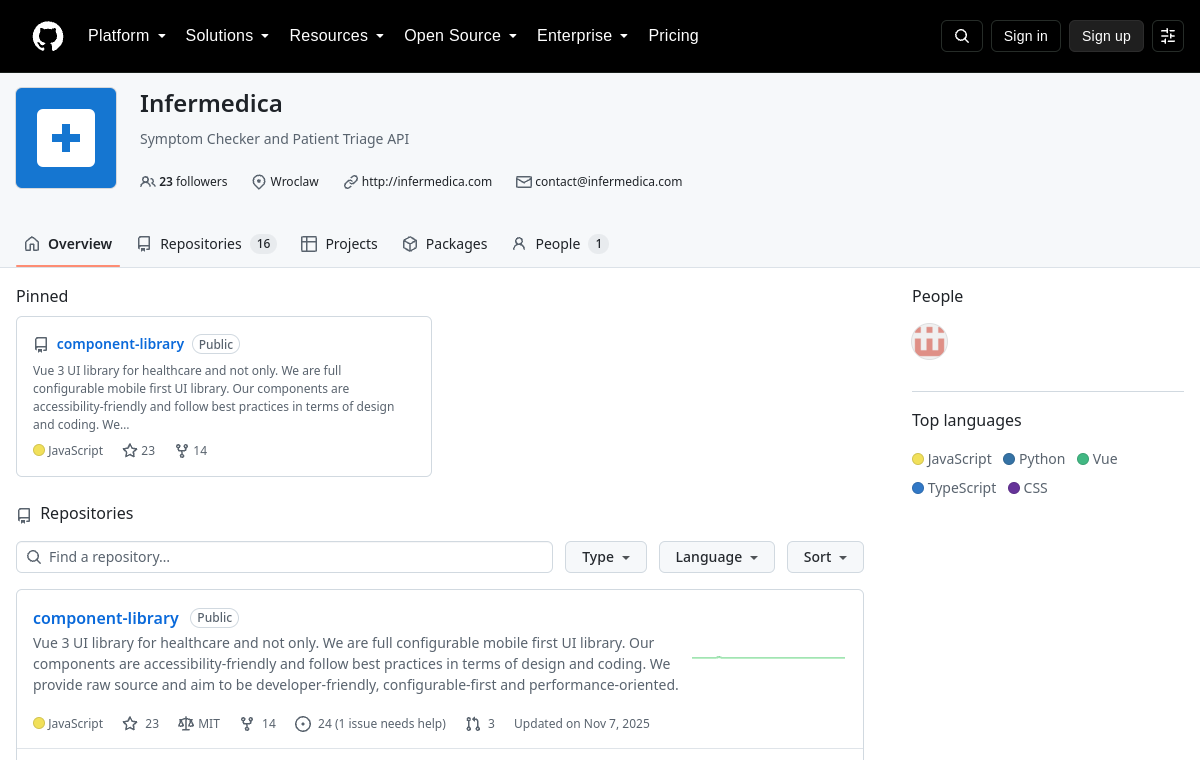
Source screenshot: Infermedica on GitHub, reviewed July 2026.
Published customer examples include:
-
Médis clinical contact center: Infermedica reports about 24,000 triage processes in the first year and coverage of 99.4% of reported symptoms. The proportion of cases directed to urgent care was 8%, compared with 17% of callers who initially intended to seek urgent care. These are vendor-reported operational outcomes, not a randomized safety trial.
-
Diagnostikare digital health platform: Its case study reports that symptom information populated the clinical back office and EHR. Average visit time fell from 20 to 12.5 minutes, while the company reported a 39% increase in operational efficiency.
-
Solv booking pathway: Infermedica reports 1.47 million completed interviews, a 56% completion rate, and more than 25% conversion from the checker to appointment booking. Users who completed the checker booked at roughly twice the rate of those who did not.
-
Healthdirect Australia: Infermedica’s research summary cites a 2025 evaluation reporting a 9% improvement in triage accuracy and a 46% reduction in overtriage compared with the earlier clinical decision-support system.
These examples can inform business cases, but each organization needs local evidence because populations, staffing, services, and escalation rules differ.
Integrating Infermedica With Epic, Oracle Health, and Healthcare Call Center Systems
The hardest parts of an Infermedica call center triage setup are usually identity matching, clinical terminology, downtime procedures, and record ownership, not the API call.
Infermedica says its integration tooling uses FHIR and HL7 standards and supports ICD-10 and SNOMED CT mappings. Its integration documentation describes importing age, sex, and demographic risk factors and exporting investigated symptoms, possible conditions, triage level, care type, and specialist recommendations. Results may also transfer as text or a PDF summary.
Before connecting Infermedica to Epic, Oracle Health/Cerner, a CRM, or a computer-telephony platform, answer these questions:
| Integration Question | What to Check | Why It Matters |
|---|---|---|
| Patient identity | Matching rules, proxy callers, newborns, and duplicate records | A correct assessment attached to the wrong person is unsafe |
| Data destination | Encounter note, flowsheet, questionnaire response, document, or inbox | Clinicians need information in a predictable location |
| Terminology | Versioned SNOMED CT, ICD-10, and local-code mappings | Mapping errors can change meaning during transfer |
| Authentication | OAuth, service accounts, token rotation, and least privilege | Clinical data should not depend on shared credentials |
| Write-back | Which fields are structured and which remain narrative | A PDF alone may be difficult to search or trend |
| Booking | Mapping triage levels to real specialties, hours, and locations | A recommendation is useless if the service cannot be reached |
| Downtime | Manual scripts and delayed reconciliation | Calls continue when an API or EHR is unavailable |
For Epic or Oracle Health, confirm which FHIR resources and interface patterns the local version supports. “FHIR compatible” does not mean plug-and-play. Test patient matching, result reconciliation, failed messages, amendments, and duplicate submissions before production use.
Infermedica Safety Limits, Nurse Triage Escalation, and Clinical Oversight
Infermedica’s /triage documentation says its classification considers the seriousness of likely conditions, alarming symptoms, and risk factors. It also describes “triage tuples,” in which combined findings can raise urgency when either alone would not. This mechanism cannot capture every presentation, communication problem, or change in a patient’s condition.
A safe Infermedica symptom checker deployment needs explicit boundaries:
- The tool does not confirm or exclude a diagnosis.
- It should not delay emergency help when severe symptoms are already apparent.
- Callers may misunderstand questions or omit information.
- Supported medical content and regulatory status may differ by country, product version, age group, and language.
- A caller’s condition may worsen after the interview.
- Local service capacity can make the nominal recommendation impractical.
Define escalation rules before launch. Immediate escalation commonly covers severe breathing difficulty, signs of stroke, major bleeding, loss of consciousness, severe allergic reactions, or stated risk of self-harm. The organization’s medical leadership and local emergency system must define the script and destination.
Agents should also escalate unmapped symptoms, conflicting answers, callers who sound sicker than the result suggests, or unreliable assessments caused by communication barriers. Infermedica’s own product guidance advises presenting Instructions for Use and explaining circumstances in which users should stop an assessment and contact a clinician.
Clinical governance should include named medical ownership, version review, override monitoring, incident investigation, and a controlled process for changing scripts. An algorithm update is a clinical change, not just a software release.
HIPAA, Privacy, and Security Questions
Infermedica’s developer site lists HIPAA, GDPR, ISO 27001, ISO 13485, SOC 2 Type 2, and EU MDR Class IIb among its current trust and compliance statements. Its Trust Center provides public and controlled-access materials, including a BAA template and compliance documents. These claims inform procurement but do not automatically make the customer’s workflow compliant.
For a US deployment involving protected health information, the health system or payer should review:
- Contracting: whether Infermedica and any hosting or transcription providers require business associate agreements
- Data flow: what information leaves the call center, where it is processed, and whether it crosses national borders
- Retention: how long interview data, recordings, transcripts, identifiers, and logs remain available
- Access: role-based permissions for agents, nurses, supervisors, developers, and vendor support
- Monitoring: audit logs, unusual-access detection, incident notification, and evidence preservation
- Patient rights: access, correction, deletion where applicable, and handling of proxy callers
Voice workflows may involve recording, transcription, and another model provider, requiring extra care. Obtain necessary consent, avoid irrelevant details, and disclose automation. Do not put sensitive production calls into analytics or development environments without an approved basis and suitable controls.
Draw the complete data-flow diagram during the first design workshop. Do not approve production use until the team knows where every interview copy goes.
How to Pilot and Measure Infermedica Clinical Decision Support
A healthcare call center pilot should test nurse triage safety before cost savings. Call duration matters, but faster misdirected calls are not an improvement. Start with a restricted population, trained users, and parallel review. Avoid beginning with the highest-risk callers or a language for which the organization has not validated scripts.
Evaluate in four stages:
-
Establish a baseline. Before introducing Infermedica, measure triage agreement, escalation, call duration, abandonment, transfers, repeat contacts, and disposition.
-
Run retrospective cases. Use de-identified local cases with an independently assigned reference disposition. Include rare emergencies, pediatric cases, pregnancy, mental-health presentations, vague symptoms, and incomplete histories.
-
Conduct a monitored pilot. Require nurse review, sample calls for quality assessment, and hold regular safety meetings. Investigate undertriage promptly rather than waiting for the pilot to end.
-
Expand only against thresholds. Predefine acceptable results and examine performance by age, language, sex-related clinical inputs, disability, and other relevant groups.
| Metric | Recommended Interpretation | Common Trap |
|---|---|---|
| Undertriage rate | Cases sent to less urgent care than the reference standard | Hiding serious errors inside overall accuracy |
| Overtriage rate | Cases sent to more urgent care than necessary | Treating every conservative result as harmless |
| Disposition agreement | Agreement with clinician or adjudication panel | Using the software’s own output as the reference |
| Override rate | Frequency and direction of nurse changes | Assuming every override is user error |
| Interview completion | Share of started assessments completed | Ignoring who abandons and why |
| Handling time | Total time from answer to disposition | Measuring screen time but excluding transfers |
| Repeat contact | New contact within a defined period | Missing contacts made through another channel |
| Equity measures | Performance across relevant patient groups | Reporting only the overall average |
Track emergency events and complaints even when volumes cannot produce stable percentages. Qualitative review often reveals problems before dashboards do.
Conclusion
The Infermedica symptom checker supports structured symptom intake, adaptive questioning, urgency classification, and care navigation. In call centers, Infermedica may standardize interviews and simplify reuse of information in booking, telehealth, and EHR workflows. Customer examples report shorter visits, fewer urgent-care recommendations, and more consistent triage, but do not guarantee those results.
The safest setup keeps a trained person accountable for the disposition, makes emergency escalation immediate, and measures undertriage separately from overall agreement. It treats Epic, Oracle Health, HIPAA, terminology mapping, and downtime planning as core clinical work. Before buying or expanding, run local cases, set safety thresholds, inspect subgroup performance, and confirm every recommendation leads to an accessible service.
Frequently asked questions
Can Infermedica replace a nurse or diagnose a caller’s condition?
No. Infermedica supports structured symptom collection, urgency assessment, and care navigation, but its outputs are not confirmed diagnoses. A trained professional should remain accountable for interpreting the information, applying local protocols, and determining the final disposition.
What should an agent do when a caller appears to have an emergency?
The agent should stop the ordinary assessment and follow the organization’s emergency protocol immediately. Severe symptoms should never be delayed while the agent completes every software-generated question.
Can nonclinical call center agents use Infermedica safely?
They may use it for structured intake within clearly defined roles, scripts, and escalation rules. It should not be used to turn nonclinical staff into unsupervised clinical decision-makers, and complex or concerning cases should be transferred to a qualified professional.
Does Infermedica integrate directly with Epic or Oracle Health?
Infermedica supports standards such as FHIR and HL7, but integration is not automatically plug-and-play. Each organization must verify supported resources, identity matching, terminology mappings, write-back locations, authentication, error handling, and local EHR capabilities.
Does using Infermedica make a workflow HIPAA compliant?
No vendor certification or compliance statement makes the complete customer workflow compliant by itself. The organization must assess contracts, data flows, access controls, retention, audit logging, hosting locations, recordings, transcription services, and any additional vendors handling protected health information.
How should an organization respond when a nurse disagrees with the triage result?
The nurse should be able to override the recommendation based on professional judgment and local protocols. The reason should be documented, and override patterns should be reviewed to identify training needs, workflow problems, or systematic limitations in the tool.
Which measures matter most during an Infermedica pilot?
Safety measures, especially undertriage, emergency events, repeat contacts, and disposition agreement with an independent clinical reference, should take priority. Organizations should also track overtriage, overrides, completion, handling time, complaints, and performance across relevant patient groups before expanding use.
Related Articles
AI Patient Engagement Software: Buyer's Guide
Compare AI patient engagement platforms for scheduling, EHR integration, privacy, safety, accessibility, equity, and measurable outcomes.
AI Clinical Documentation: Buyer's Guide
Evaluate ambient AI scribes for EHR integration, accuracy, HIPAA security, specialty fit, pilot design, coding, and clinical safety.
Zanus AI for Hospitals: Evaluation and Buyer Guide
Evaluate Zanus AI for hospital use, including EHR integration, HIPAA security, clinical evidence, pilot metrics, and procurement risks.